Defense only
No attack functions. Demo pcaps are written to files and never transmitted. Automatic response is dry-run by default behind a double gate.
AI-based network and host intrusion detection and a malware scanner, extended in v1.1 with real-time pre-emptive defense, a monitoring UI and reports — one CLI, one config file, one logs folder.
Version documented: manual v1.1 / software aisec 1.1.0. Python tool suite with a single CLI (main.py, also aisec).
| Component | What it does | Technology |
|---|---|---|
| NIDS (network intrusion detection) | pcap files or live capture → bidirectional flows → 33 NSL-KDD-compatible + 20 extended features → 4-model ensemble vote → JSONL alerts with an attack-type hint | Scapy, Isolation Forest, Random Forest, LightGBM, PyTorch Autoencoder |
| HIDS (host log anomaly detection) | auth.log / syslog parsing → message templates, rarity and per-IP time-window features (26) → anomalous-line detection | Regex parsers, Isolation Forest |
| Malware scanner — static | PE header / sections / entropy / imports / strings (55 features) → XGBoost probability with SHAP contributions, YARA rules | pefile, yara-python, XGBoost |
| Malware scanner — dynamic | Cuckoo/CAPE sandbox behavior reports (JSON, 39 features) → classification. The file is never executed | scikit-learn Random Forest |
| VirusTotal integration | SHA-256 hash reputation lookup (no upload), cache and rate limit, skipped automatically without a key | VirusTotal API v3 |
| Real-time defense (v1.1) | Input sources → detectors → policy → safety gate → responses, all audited | aisec defend |
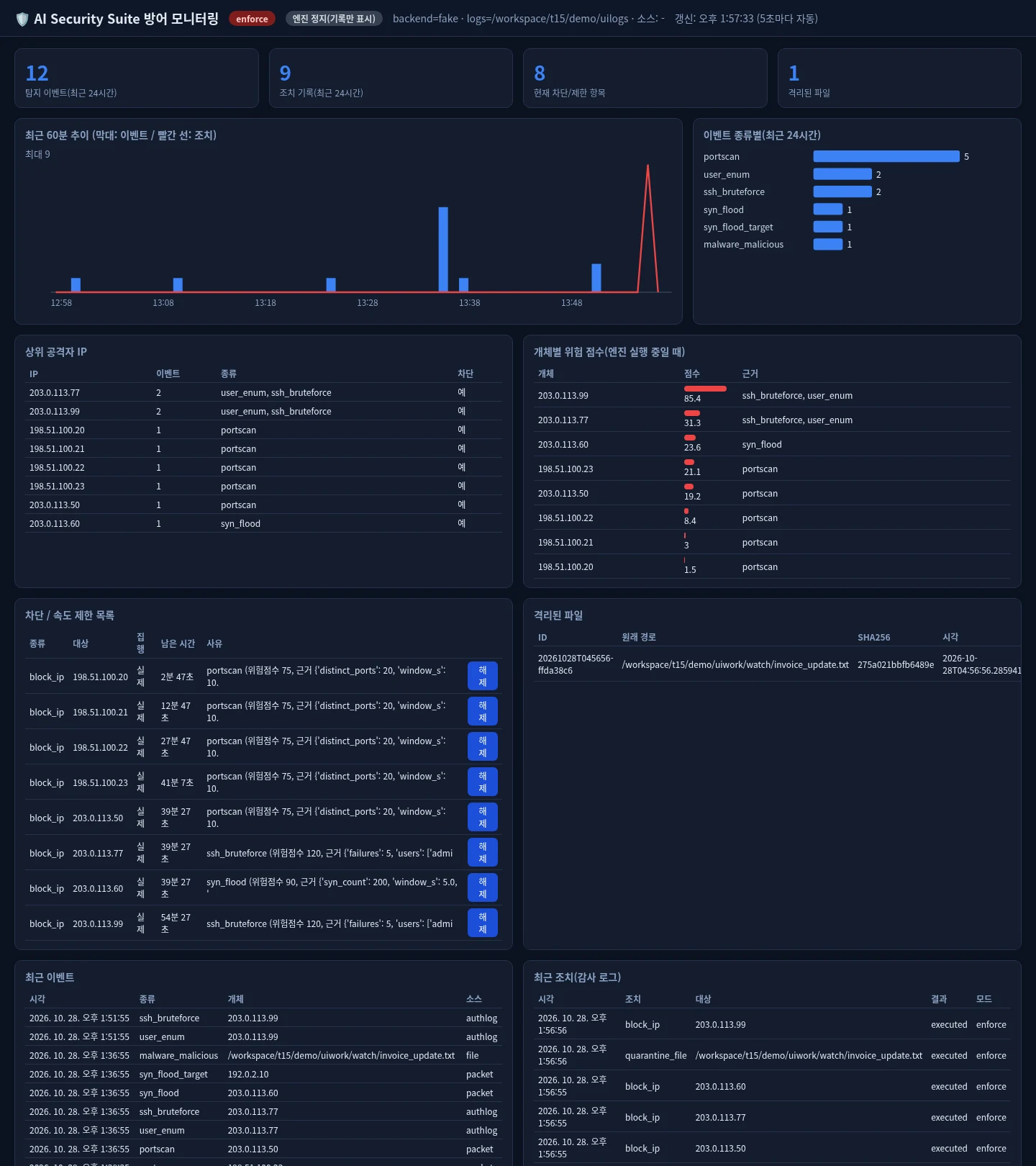
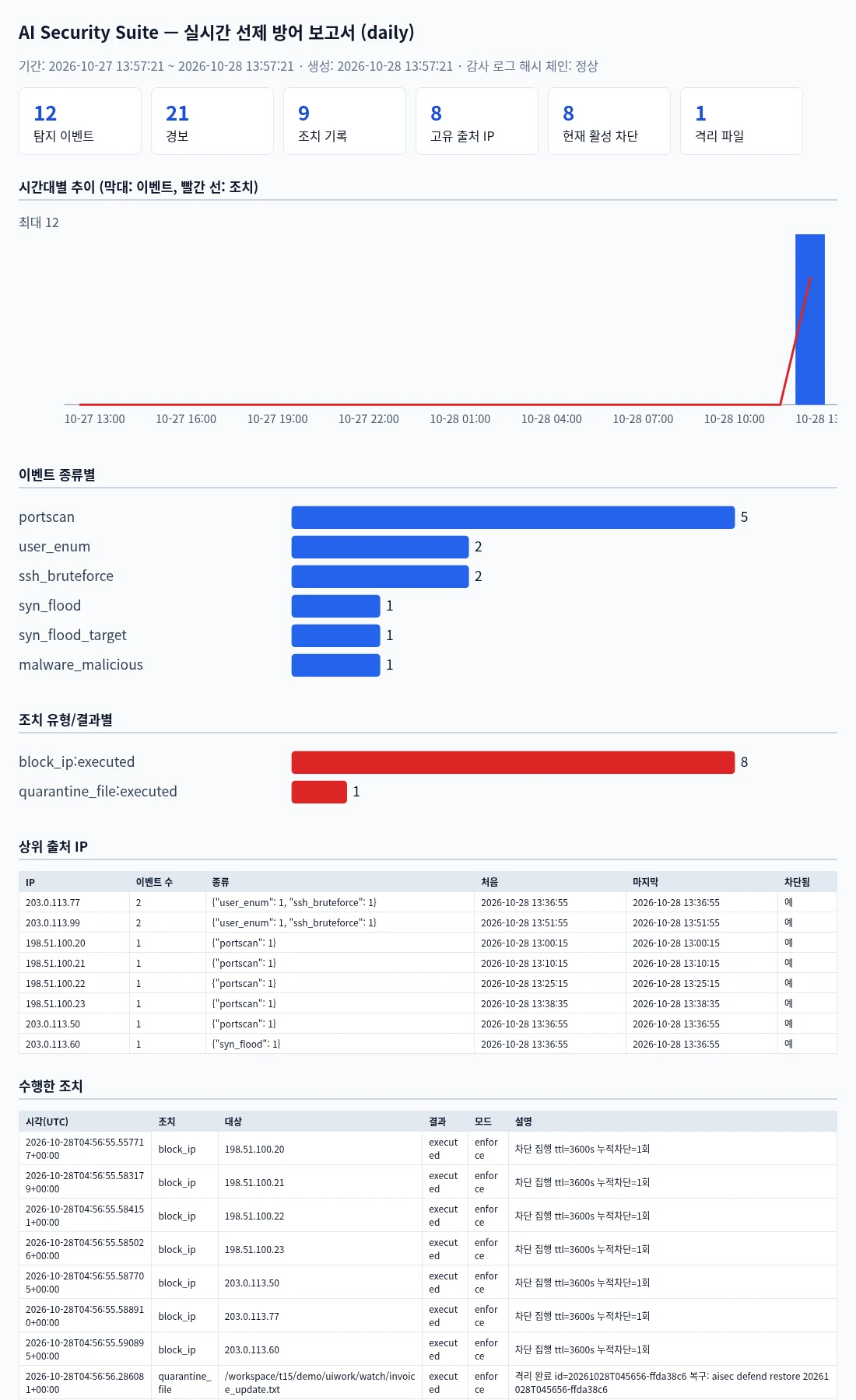
| Monitoring UI & reports (v1.1) | Local web dashboard and daily/weekly/custom reports | aisec ui, aisec report |
Turns packets into flows and scores them with several models, so no single model decides alone.
min_votes models agree (default: majority).Learns what normal auth.log / syslog looks like on your host and flags what is new or bursty.
ip_fail_window → brute force.Static, rule-based, reputation and behavior signals combined into one explainable verdict — without ever running the file.
v1.1 adds an engine that receives threats, decides by policy and responds — with the brakes on by default.
syn_flood_target) so victims are not blocked by mistake.See what the engine saw and did — and hand a readable report to management or auditors.
--allow-actions.Redrawn from the manual’s architecture figure. Blue dashed arrows are read-only; the dashboard’s release and restore buttons are the only write path and need their own gate.
Scroll sideways to see the whole diagram.
No attack functions. Demo pcaps are written to files and never transmitted. Automatic response is dry-run by default behind a double gate.
The malware scanner only reads bytes. Dynamic analysis consumes JSON reports from an external sandbox.
NSL-KDD download falls back to synthetic data, VirusTotal is skipped without a key, tests pass without a network.
The synthetic generator and the real packet parser share the same FlowRecord aggregation path to minimise feature mismatch.
Attack-type hints and key features (NIDS), contributing features (HIDS), SHAP values (static ML) and evidence (dynamic).
JSON Lines alerts and JSON results can be ingested by SIEMs such as Splunk or Elastic; exit codes (0 / 1 / 2) fit automation.
| Item | Recommended / verified | Notes |
|---|---|---|
| OS | Linux x86_64 (verified: Debian family) | Windows / macOS can analyze pcaps and scan files; live capture needs Npcap and privileges. Real blocking was verified on Linux only. |
| Python | 3.10+ (verified: 3.13.5) | Virtual environment recommended |
| Memory | 4 GB+ (about 1.5 GB for a full NSL-KDD training) | 8 GB+ recommended for full CIC-IDS2017 |
| Disk | About 2 GB (venv with PyTorch CPU ≈ 1.8 GB) | Datasets are extra |
| Privileges | Live capture: root or CAP_NET_RAW · real blocking: root or CAP_NET_ADMIN | pcap analysis, scans, log/file watching, UI and reports run as a normal user |
| Firewall | nftables or iptables (Linux) | If neither exists the engine runs in dry-run; macOS has no firewall backend |
Screenshots taken from the product documentation. Both were produced with demo data.
Tell us about your network, hosts and constraints. We will propose a dry-run-first pilot plan — no obligation.